
I’ll be honest — when I first heard about the Tata Nano EV, I felt a strange nostalgia. If you were around in 2009–2015, you already know what the Nano meant to Indian families. It wasn’t just a car. It was hope on four wheels.
Back then, Tata Motors tried to give middle-class families a safe alternative to scooters. The idea was simple: every family deserved a car. The Nano didn’t succeed commercially the way people expected… but emotionally? It became unforgettable.
Now imagine the same idea returning in 2026 — but electric.
Honestly speaking, this time the timing is perfect.
Petrol prices are painful. Cities are crowded. Parking is impossible. And EV adoption in India is finally real. That’s exactly why the 2026 Tata Nano EV might become one of the most important cars Tata has ever launched.
And yes — this isn’t just rumor anymore. The market conditions, Tata’s EV leadership, and growing demand for affordable EVs make this comeback extremely logical.
Let’s talk about what we can realistically expect.
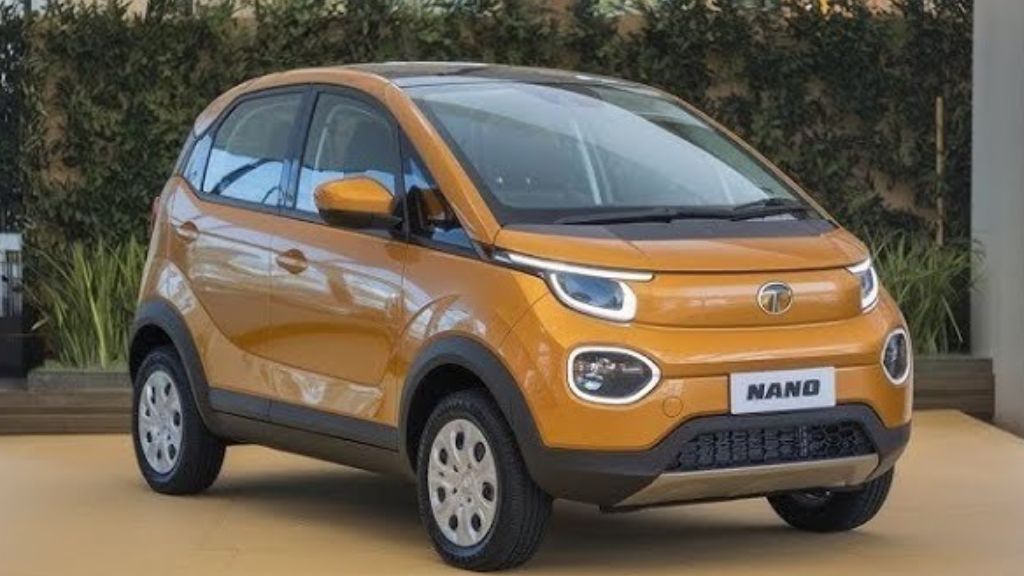
Why Tata Is Bringing Back the Nano — And Why It Makes Sense Now
Back in 2009, India wasn’t ready.
People judged the Nano because it was marketed as the “cheapest car.” In India, status matters. Buyers wanted value, but not the label of “cheap.” The perception hurt sales.
But the world has changed.
Today, buyers want:
- Low running cost
- Easy city driving
- Eco-friendly vehicles
- Less maintenance
That is literally the exact environment where a small electric car wins.
Tata Motors already dominates India’s EV market with:
- Nexon EV
- Tiago EV
- Tigor EV
- Punch EV (recent success)
Now there is only one missing piece — a true entry-level EV under ₹5 lakh–₹6 lakh segment.
And the Nano platform fits perfectly.
Surprisingly, the original Nano was ahead of its time. Lightweight body, compact footprint, and city focus — those qualities actually suit electric cars better than petrol cars.
The best part is: electric vehicles don’t need large engines or gearboxes. That frees up space, improves efficiency, and makes small cars practical again.
Expected Launch Date in India
Tata Motors hasn’t officially announced the car yet, but honestly, all industry signs point to a 2026 launch window.
Why 2026?
Because Tata is currently:
- Expanding charging infrastructure
- Scaling battery production
- Preparing low-cost EV platforms
Industry analysts expect unveiling at Auto Expo 2026 with sales starting late 2026 or early 2027.
Expected Price of Tata Nano EV
This is the biggest question everyone asks.
To be honest, price will decide everything.
Experts predict:
Expected price: ₹4 lakh – ₹6 lakh (ex-showroom)
If Tata achieves this, the Nano EV could become:
India’s first truly mass-market electric car.
And suddenly:
- College students
- Delivery drivers
- Small families
- Office commuters
— all become EV buyers.
Running cost may drop to ₹0.80–₹1 per km.
Compare that with petrol scooters costing ₹2.5–₹3 per km.
That alone can change the market.
Battery, Range & Performance (Expected)
Tata will most likely use a modified version of the Ziptron EV technology — the same trusted system used in Nexon EV and Tiago EV.
Expected Specifications
- Battery pack: 17–22 kWh
- Range: 200–250 km (realistic city range)
- Motor: 35–45 hp electric motor
- Top speed: ~85–95 km/h
- Charging time: 4–5 hours (home charger)
Honestly speaking, for a city car, this is more than enough. Most Indian daily drives are under 30 km per day.
You would probably charge it only twice a week.
Charging — The Real Advantage
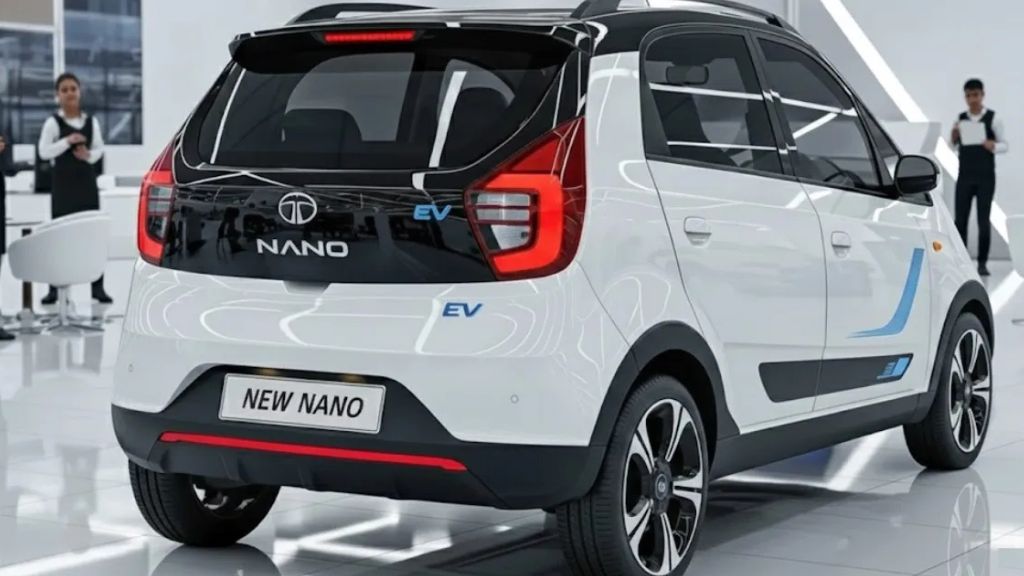
Here’s where the Nano EV becomes powerful.
Unlike big EVs, this car won’t need a fast charger.
You can simply:
Plug it into your house socket at night.
Wake up.
Battery full.
No petrol pump visits.
No waiting lines.
No engine heat.
To be honest, once you get used to home charging, going back to petrol feels outdated.
Exterior Design — Modern but Familiar
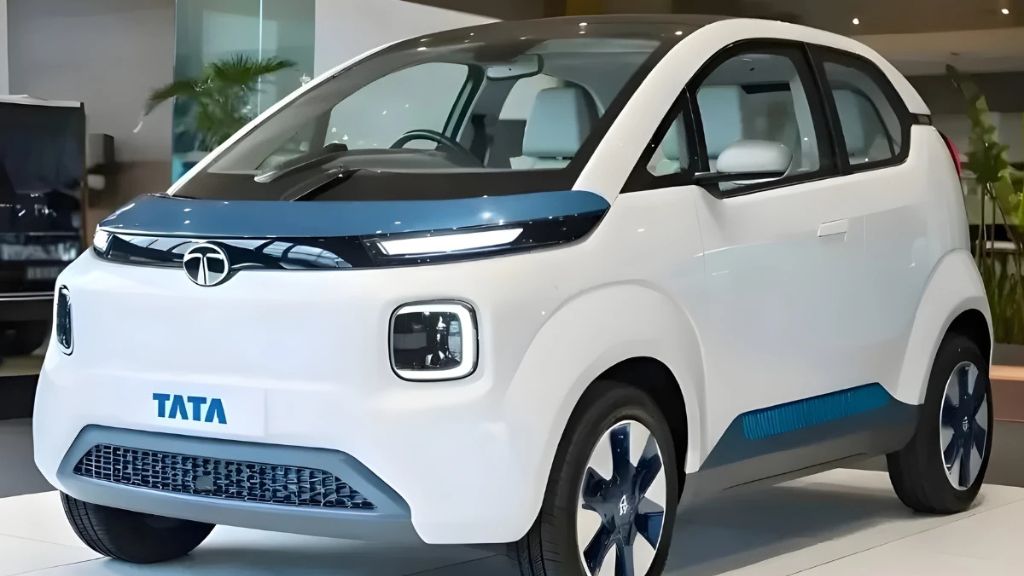
Tata won’t repeat the old Nano’s toy-car look.
Expect:
- LED DRLs
- Closed EV grille
- Projector headlamps
- New alloy wheels
- Sporty bumper
- Tall-boy hatchback stance
It will likely resemble a mini Punch EV.
Compact size will remain its biggest strength. In Indian cities, small size is not a compromise — it’s a superpower.
Parking becomes effortless.
Interior & Cabin Features
This is where Tata has improved massively in recent cars.
Expected interior features:
- 7-inch touchscreen infotainment
- Wireless Android Auto & Apple CarPlay
- Digital instrument cluster
- Steering mounted controls
- Power windows
- Automatic climate control (top variant)
- Connected car tech
Honestly speaking, if Tata offers these features at Nano pricing, competitors will panic.
Safety — This Time It Matters
Old Nano failed because people doubted safety.
Tata understands this now. The company is known for strong safety ratings (Nexon and Punch scored high crash ratings).
Expected safety features:
- Dual airbags
- ABS with EBD
- Rear parking sensors
- Reverse camera
- Stronger body shell
- High-strength steel platform
This alone changes the perception completely.
Running Cost — Why Everyone Is Interested
Let’s do simple math.
Petrol hatchback:
₹110 per litre
Mileage 18 km/l
Cost per km ≈ ₹6
Nano EV:
Electricity ₹8 per unit
Full charge ₹120
Range 220 km
Cost per km ≈ ₹0.55
Honestly… this is the real revolution.
Over 5 years you may save ₹2–3 lakh in fuel.
Who Should Buy Tata Nano EV?
I genuinely think this car is perfect for:
• First-time car buyers
• Daily office commuters
• Students
• Delivery business owners
• Women drivers (easy city driving)
• Retired people
• Second car for families
It’s not a highway touring car.
It’s a practical urban mobility solution.
Competitors
Surprisingly, Nano EV may not have direct competition.
Closest options:
- MG Comet EV (expensive for size)
- Tata Tiago EV (higher price segment)
Nano EV could create a new segment: ultra-budget EV cars.
10 Frequently Asked Questions (FAQs)
1. What is the launch date of Tata Nano EV?
Expected to launch around Auto Expo 2026 with deliveries starting late 2026 or early 2027.
2. What will be the price of Tata Nano EV?
Estimated ₹4–6 lakh ex-showroom.
3. What range will Tata Nano EV offer?
Expected real-world range around 200–250 km per charge.
4. Can it be charged at home?
Yes, normal 15A household socket charging will be supported.
5. Is Nano EV safe?
It is expected to include airbags, ABS, and a stronger chassis compared to the old Nano.
6. What is the top speed?
Likely around 85–95 km/h, suitable for city and short highway drives.
7. Is Tata Nano EV better than a petrol car?
For city use, yes — far lower running cost and maintenance.
8. How much electricity will it consume?
Approximately 7–9 units per full charge.
9. Will it support fast charging?
Entry variants may not, but higher trims could offer optional fast charging.
10. Who is the ideal buyer?
Urban commuters and first-time car owners.
Final Thoughts
To be honest, the Nano failed once not because it was a bad car — but because it was misunderstood.
Now the world has changed.
People don’t want big cars anymore. They want smart mobility. Affordable travel. Low maintenance. Easy parking. Low fuel expense.
And suddenly, the Nano’s original idea feels modern.
If Tata prices it correctly, the 2026 Tata Nano EV could become India’s iPhone moment for electric vehicles — the point where EVs stop being premium and start becoming normal.