
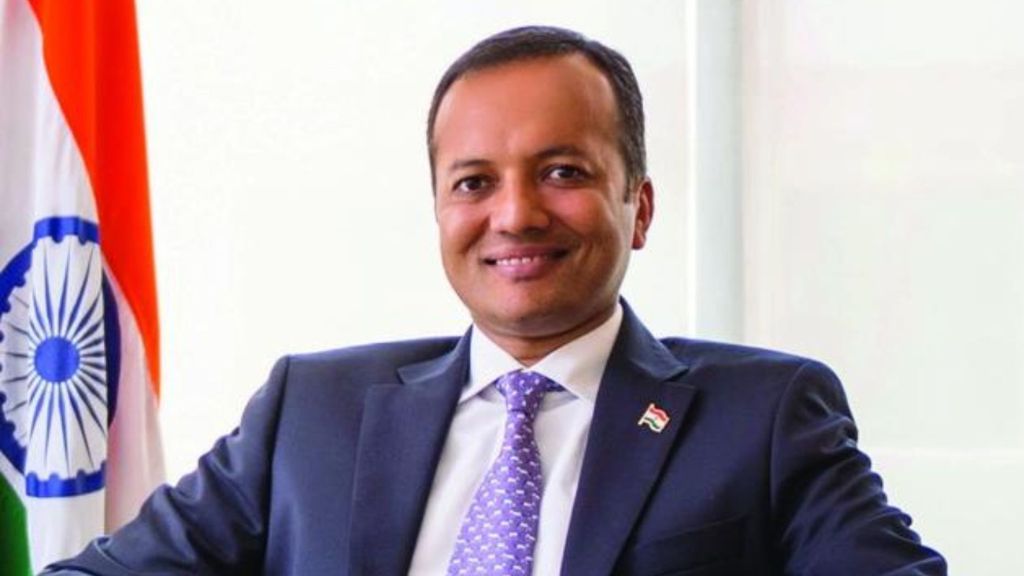
Naveen Jindal — born 9 March 1970 — belongs to one of India’s most influential industrial families. He has served as the head of the steel‑power conglomerate Jindal Steel and Power Ltd (JSPL), and over decades he has grown the company into a major player in steel, power, mining and infrastructure. Moreover, he has ventured into public life: Jindal has participated in politics, contested elections, and held public office in his political journey.
Under his leadership JSPL transformed from a modest enterprise into a diversified conglomerate with operations across multiple states in India, producing steel and power at large scale, and venturing into mining and associated sectors. This industrial legacy, combined with his business acumen and diversified investments, forms the core of his wealth.
2. What is His Publicly Declared Wealth (2024–2025)?
When considering net worth, a key reference is the affidavit and asset declarations submitted by Jindal — especially for elections. According to his latest public disclosure (when filing nomination for 2024 elections), the combined declared assets of him and his wife are near ₹ 1,000 crore.
- His declared movable assets amount to around ₹ 886 crore, while his wife’s movable assets are around ₹ 114 crore.
- Additionally, their declared immovable assets stand at roughly ₹ 11 crore.
- On top of that, the couple reportedly own gold and jewellery valued at over ₹ 40 crore.
These declarations suggest that their total combined assets (movable + immovable + valuables) cross the ₹ 1,000 crore mark.
Some recent assessments of his overall wealth — taking into account broader investments and business holdings — estimate the total net worth to be around ₹ 1,230–1,240 crore.
Thus, based on publicly available and legally declared data, a conservative yet credible estimate of his net worth in 2024–25 lies in the ballpark of ₹ 1,200–1,250 crore.
3. How Did Naveen Jindal Accumulate This Wealth — Sources & Growth
Industrial Empire — Steel, Power & Mining
The lion’s share of Jindal’s wealth stems from JSPL — his flagship company. Over decades, under his guidance, JSPL expanded operations across steel manufacturing, power generation, captive mining, and infrastructure. Such diversified presence allowed JSPL to leverage backward and forward integration (mining → steel → power) and capitalize on India’s infrastructure and industrial growth.
Coal-based steel production and captive power generation gave JSPL — and thereby Jindal — a competitive edge, especially when global and domestic demand for steel rose. Expansion of plants, investment in coal and iron-ore mines, and establishment of captive power units all helped in building substantial industrial assets.
Investments and Asset Diversification
Besides steel and power, Jindal’s wealth portfolio includes real estate (residential and commercial), mining rights, corporate shareholdings, and other movable assets (liquid investments, cash, jewellery, etc.). This diversification means that while steel and power remain core, other assets also contribute to his net worth — offering stability against sector-specific volatility.
Strategic Positioning & Long-term Vision
Stepping into multiple sectors — steel, power, mining — and maintaining a long-term vision for conglomerate growth allowed Jindal to build lasting value. Rather than short-term gains, Jindal’s strategy appears grounded in building infrastructure, capacity, and integrated business units — which over decades have translated into substantial net worth.
4. What the Numbers Don’t Show — Important Limitations
While the declared ₹ 1,200–1,250 crore gives a baseline, it may not reflect full economic value for several reasons:
- Market Valuation: The value of industrial assets (steel plants, power units, mines) can fluctuate drastically depending on commodity demand, global steel prices, regulatory environment, and operational performance. The declared asset value may underrepresent or overrepresent real-time market value.
- Unlisted/Private Holdings: Some business interests, investments, or assets may be privately held or in entities that do not publicly disclose valuation — hence not part of the official declaration.
- Liabilities and Debt: Public declarations focus on assets; company debts, loans, future liabilities — though sometimes disclosed — may not always be fully transparent or accurately reflect future obligations.
- Illiquid Assets and Real Value: Real estate, land, mining rights, infrastructural assets — these are illiquid and can have vastly different valuations depending on location, regulatory changes, demand, and market sentiment. Their true worth may only be realised over long periods.
- Dynamic Business Environment: Changes in steel demand, regulatory policies (mining, environment), cost of raw materials, global steel market cycles — all these can significantly influence the real net worth over time, making any static figure a rough snapshot, not a permanent value.
Hence, while the declared wealth offers a credible baseline, true economic value (or “real net worth”) might differ when all dynamic factors are considered.
5. Why Naveen Jindal’s Net Worth Matters — Influence Beyond Wealth
The financial standing of an industrialist like Jindal is significant not only in monetary terms — it reflects industrial capacity, employment potential, infrastructure development, and economic influence.
As the head of a major steel‑power conglomerate, his decisions impact steel output, availability of steel and power, mining policies, supply chains — which in turn affect regional economies, job creation, industrial growth and national infrastructure projects.
Moreover, as a public figure and politician, his wealth disclosure becomes a matter of public interest: transparency, accountability, and the interplay between business and politics — all crucial in a democratic setup.
Combined with investments across sectors, diversified asset base, and a legacy business, Jindal’s wealth underscores how industrial consolidation and strategic investments can translate into lasting influence.

6. Final Thoughts — What We Can Conclude
If we rely strictly on publicly declared assets and latest affidavits, as of 2024–25, Naveen Jindal’s net worth seems to hover around ₹ 1,200–1,250 crore.
However, given the scale of his business empire, diverse holdings, and industrial assets whose market value could be significantly higher, the real economic value of his wealth may well exceed this figure — though exact quantification is hard without full disclosure of all holdings, valuations, liabilities, and market conditions.
In short: Jindal remains a prominent industrialist with substantial wealth — rooted in legacy, diversified business interests, and long-term vision. But any “billionaire‑level (in USD)” tag must be treated with caution unless backed by verifiable valuations.